San Diego Bay’s Storied Past: A Journey Through Time
Why San Diego Bay’s History Matters
San Diego Bay history spans thousands of years, from indigenous Kumeyaay settlements through Spanish exploration, Mexican rule, and American naval dominance to today’s thriving recreational harbor. This natural deepwater port shaped Southern California’s development and remains one of the region’s most valuable resources.
Key Historical Milestones:
- Pre-1542 – Kumeyaay tribes thrived on the bay’s shores, using it for fishing, hunting, and gathering
- September 28, 1542 – Juan Rodriguez Cabrillo became the first European to explore the bay, naming it “San Miguel”
- 1602 – Sebastián Vizcaíno renamed it “San Diego” in honor of Saint Didacus
- 1769 – Spanish established Mission San Diego de Alcalá, California’s first mission
- 1848 – Treaty of Guadalupe Hidalgo transferred the bay to United States control
- 1901 – U.S. Navy established its first presence, beginning San Diego’s identity as “Navy Town”
- 1962 – Port of San Diego officially formed to manage the harbor
- 1969 – San Diego-Coronado Bridge completed, changing the bay’s skyline
The bay’s story is one of continuous change: from a pristine harbor for Native Americans to a Spanish outpost, a Mexican trade port, and America’s largest West Coast naval base.
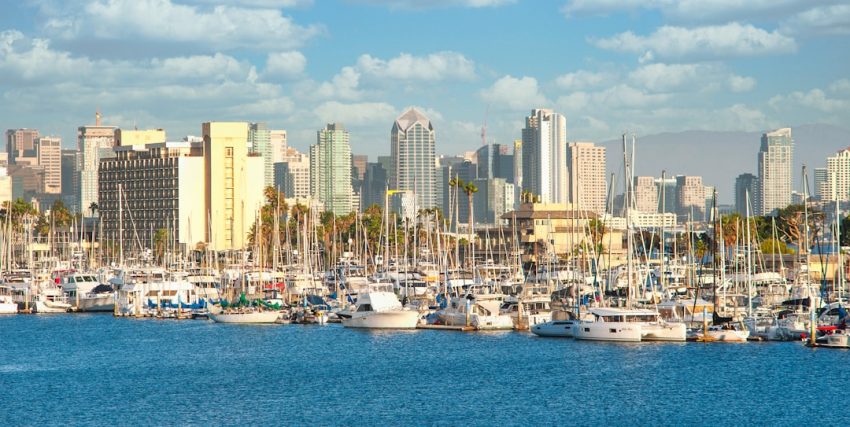
Today, San Diego Bay stretches 12 miles long and covers 19 square miles of water. Its protected waters have witnessed everything from indigenous fishing canoes and Spanish galleons to whaling ships, modern aircraft carriers, and the countless recreational vessels that now share its waters.

The Dawn of an Era: From Indigenous Lands to European Find
The rich San Diego Bay history began long before Europeans arrived. For thousands of years, this natural harbor was home to thriving Kumeyaay communities whose deep connection to the land and water laid the groundwork for everything that followed.
On September 28, 1542, Spanish explorer Juan Rodriguez Cabrillo became the first European to enter the bay, naming it “San Miguel.” His expedition sought a shorter trade route to the Orient, the mythical Strait of Anian. While he didn’t find it, he was the first European to map many Pacific Coast bays, including San Diego Bay.
Over half a century later, in 1602, another Spanish expedition led by Sebastián Vizcaíno arrived. Vizcaíno carefully charted the coast and, finding Cabrillo’s descriptions lacking, renamed the bay “San Diego” on November 10, 1602, in honor of Saint Didacus (San Diego de Alcalá). His goal was to identify safe ports for Manila galleons. Vizcaíno’s detailed charts proved invaluable for future Spanish settlement, though the bay was largely forgotten for decades.
The Kumeyaay: The Bay’s First Inhabitants
Before European contact, the San Diego Bay region was the ancestral homeland of the Kumeyaay people. These native tribes thrived for thousands of years, using the bay’s abundant resources for their livelihood. The indigenous population numbered roughly 20,000 at the time of European contact, demonstrating a well-established society.
When the Kumeyaay first encountered the Spanish, interactions were mixed. During Cabrillo’s 1542 visit, most Kumeyaay fled, but three who remained were offered gifts. Later, a Spanish fishing party was attacked with arrows, marking the first recorded conflict between Europeans and native Californians and setting a tense precedent.
By the time Sebastián Vizcaíno arrived in 1602, interactions were less violent. His expedition involved gift exchanges, and records mention an elderly Kumeyaay woman who showed the Spanish a nearby village. This suggests the Kumeyaay had a sophisticated understanding of their territory.
European Arrival and Renaming the Bay
The arrival of Spanish explorers like Juan Rodriguez Cabrillo and Sebastián Vizcaíno marked a turning point in San Diego Bay history. Cabrillo, a Portuguese navigator for Spain, sailed into the bay on September 28, 1542. His mission was to find new trade routes to the Orient, particularly the elusive Strait of Anian. He named the bay “San Miguel” for the feast day of Saint Michael.
Cabrillo’s brief visit and rudimentary charting meant the bay was overlooked for over 60 years. Not until Sebastián Vizcaíno’s 1602 expedition did the bay re-enter European consciousness. Vizcaíno was ordered to chart the California coast, find suitable ports, and claim them for Spain. He undertook a detailed survey, recognized the harbor’s potential, and officially renamed it “San Diego” on December 12, 1602, honoring Saint Didacus. This name has endured.
Vizcaíno’s comprehensive charts provided a persuasive account of the bay’s advantages. He described a harbor with ample resources and protected waters, with a capacity greater than Acapulco. This detailed information, as highlighted by the San Diego History Center in their article Sebastian Vizcaino and San Diego Bay, was crucial for future Spanish colonization.
Shaping the Harbor: Spanish, Mexican, and American Eras
The period following European findy saw San Diego Bay transform under successive imperial powers. The Spanish, Mexican, and American eras each left an indelible mark on the bay’s development, shaping it from a remote outpost to a strategic international port.
The Spanish influence began with the establishment of the Mission San Diego de Alcalá in 1769, California’s first European settlement. Following Mexico’s independence from Spain in 1821, the bay entered its Mexican era. This period saw the rise of the rancho system, with the bay becoming a hub for the hide and tallow trade, as described by Richard Henry Dana Jr. in “Two Years Before the Mast.”
The mid-19th century brought rapid change with the Mexican-American War and the 1848 Treaty of Guadalupe Hidalgo, which transferred San Diego to U.S. control. The California Gold Rush attracted waves of settlers, boosting the bay’s importance as a port for supplies and transit. This American influx fundamentally reshaped San Diego’s future.
The Mission Period and Spanish Colonial Influence
The establishment of the Mission San Diego de Alcalá in 1769 by Father Junípero Serra was the genesis of European settlement in California and a cornerstone of San Diego Bay history. Located inland from the bay, the mission and the Presidio of San Diego were California’s first European settlement, marking Spain’s effort to extend its control northward.
During this period, the bay’s primary role was to support the mission and presidio. Spanish influence meant religious conversion efforts for the Kumeyaay and agricultural development. Native labor was integral to the mission’s growth, often under coercive conditions, and the bay served as a vital supply line to the broader Spanish colonial network.
The Mexican Rancho Era and Maritime Trade
With Mexico’s independence from Spain in 1821, San Diego Bay entered its Mexican era. This period brought significant changes, notably the secularization of missions and the redistribution of their lands into private ranchos. Cattle ranching flourished, and the bay became a busy center for the hide and tallow trade. Ships from around the world, particularly American vessels, anchored in the bay to collect these commodities.
This commerce transformed San Diego into a rugged port town. The port evolved from a mission outpost to an “entrepôt for hides and tallow,” a crucial link in the global economy. While the population remained small, the bay’s role in maritime trade during the Mexican era underscored its economic potential.
Americanization and the Rise of “New Town”
The Americanization of San Diego Bay began with the 1848 Treaty of Guadalupe Hidalgo, which ceded California to the U.S. and fundamentally altered San Diego Bay history. The bay was now in American territory, and its strategic value for U.S. Pacific expansion became undeniable. The border with Mexico was established just south of the bay, one marine league from its southernmost point.
The mid-19th century saw an influx of settlers, spurred by the Gold Rush, making San Diego a critical port. Visionaries like William Heath Davis and Alonzo Horton recognized the bay’s potential. Davis first attempted to establish “New San Diego” on the waterfront in 1850. Horton’s later efforts succeeded, developing what is now downtown San Diego and shifting the city’s center from Old Town to the waterfront. This began modern San Diego’s urban and economic development, tied directly to the bay.
A Century of Change: The Complete San Diego Bay History
The late 19th and 20th centuries brought the most dramatic changes in San Diego Bay history. What was once a pristine natural harbor underwent significant physical alterations driven by commercial, military, and industrial growth. The bay’s geography was fundamentally reshaped through dredging and the creation of new landmasses.
Taming the River: A Fight to Save the Harbor
A persistent challenge was the unpredictable San Diego River. It often shifted course, sometimes flowing into San Diego Bay and depositing immense quantities of silt that threatened to destroy the harbor’s channels. At other times, it diverted into what Cabrillo had named “False Bay” (now Mission Bay). This danger was recognized as early as 1846.
To combat this threat, the U.S. Army Corps of Engineers built a dike in 1852 to redirect the river permanently into Mission Bay. This was crucial for preserving the bay’s deep-water capabilities. Despite this, major floods continued to challenge control measures. Today, a flood control channel manages the river’s course, protecting the harbor.
Dredging and Development: A Man-Made Marvel
The change of San Diego Bay into a modern port involved extensive dredging and land creation. Channels were deepened to accommodate larger vessels, reaching a maximum dredged depth of 60 feet. The most visible results are the man-made Harbor Island and Shelter Island, created from dredge spoils. This process provided new land for development, including parts of the San Diego International Airport. The Port of San Diego was established in 1962 to manage the bay’s tidelands and continued development. These changes turned a natural inlet into an engineering marvel.
An Industrial Powerhouse: From Whaling to Shipbuilding
Throughout its American history, San Diego Bay has been an industrial powerhouse. In the mid-19th century, the bay supported a robust shore whaling industry, with stations operating from 1858 to 1886. Historical accounts mention as many as fifteen whales being seen in the bay in 1872.
As the 20th century dawned, the bay became the “Tuna Capital of the World,” with a thriving fishing industry and canneries lining the waterfront. Other industries, like lumberyards, also supported the region’s construction boom.
Today, shipbuilding remains a vital part of the bay’s industrial heritage. General Dynamics NASSCO is the only shipyard on the West Coast capable of building and repairing large ocean-going vessels. Its operations were crucial during World War II, supporting the war effort by building and repairing countless Navy ships. This evolution from whaling to global shipbuilding highlights the bay’s adaptability and economic significance.
The Navy’s Anchor: Military and Modern Infrastructure
The U.S. Navy’s relationship with San Diego Bay is arguably one of the most defining chapters in its history. Recognizing the bay’s exceptional natural harbor—a rare deep-water, landlocked port on the Pacific Coast—the Navy established its first presence in 1901. This marked the beginning of San Diego’s identity as “Navy Town” and solidified the bay’s strategic importance for national defense.
Over the decades, San Diego Bay has evolved into one of the largest naval bases in the United States, becoming a critical homeport for the U.S. Pacific Fleet. While the primary base for the Pacific Fleet shifted to Pearl Harbor before WWII, San Diego Bay remained a vital hub for naval operations, training, and logistics. Today, the U.S. Navy maintains four major facilities directly on San Diego Bay, each playing a crucial role in national security.
The U.S. Navy’s Enduring Presence in San Diego Bay history
The U.S. Navy’s footprint on San Diego Bay is truly immense and has profoundly shaped the region’s economy and culture. We are proud to share our waters with such a significant part of American history. The four primary naval facilities that call San Diego Bay home are:
- Naval Air Station North Island (NAS North Island): Located on the northern part of Coronado, this is the birthplace of Naval Aviation and a critical base for aircraft carriers and aviation squadrons.
- Naval Station San Diego (32nd Street Naval Base): The largest U.S. Navy base on the West Coast, serving as the principal homeport for the Pacific Fleet’s surface ships.
- Naval Base Point Loma: Home to submarines, the Naval Mine and Anti-Submarine Warfare Command, and the Space and Naval Warfare Systems Command.
- Naval Amphibious Base Coronado: A major training and operating base for Navy SEALs and other special operations forces.
These facilities represent the only remaining major naval base complexes in California, solidifying San Diego Bay’s unparalleled importance to the U.S. Navy. The arrival of the USS Langley, the Navy’s first aircraft carrier, in 1924, was a landmark event. The Navy’s presence provides a massive economic impact, employing thousands and attracting a diverse population to our vibrant city.
Bridging the Bay: Modern Engineering Feats
The development of modern infrastructure has dramatically impacted San Diego Bay history, none more so than the iconic San Diego-Coronado Bridge. Completed in 1969, this gracefully curving bridge became an instant landmark, connecting San Diego with Coronado Island and forever altering the bay’s skyline. Its construction was a marvel of engineering, though it famously has a vertical clearance insufficient for Nimitz-class aircraft carriers, which must be moved out into the bay before passing underneath.
The bridge also marked the obsolescence of the ferry system that had long transported people and vehicles across the bay. While we sometimes miss the charm of the old ferries, the bridge greatly improved connectivity and facilitated further development. Beyond the bridge, the bay’s waterfront has seen extensive development, including the San Diego Convention Center, numerous hotels, and attractions that draw visitors from around the world. The proximity of San Diego International Airport, much of it built on reclaimed bay land, further underscores how infrastructure development has transformed the bay into a global gateway.
The Bay Today: Recreation, Culture, and Conservation
Today, San Diego Bay is a vibrant hub of activity, balancing its historical roles with modern demands for recreation, culture, and environmental stewardship. Its protected waters and picturesque surroundings make it a magnet for locals and tourists alike, offering a diverse array of experiences. We are privileged to call this dynamic waterway our home.
A Playground on the Water: Modern Recreation and Culture
For us at San Diego Sailing Adventures, the bay is our playground, our classroom, and our passion. Sailing is, of course, a premier activity, with numerous yacht clubs dotting the shoreline and regattas happening year-round. But the bay offers so much more!
One of the most unique aspects of San Diego Bay history is its role as a living museum. Ten museum ships call San Diego Bay home, offering a tangible connection to maritime heritage. Among them are true legends:
- USS Midway Museum: A decommissioned aircraft carrier, now a floating museum.
- Star of India: Built in 1863, she is the world’s oldest active sailing ship and the oldest iron-hulled merchant ship afloat. Our own “Liberty,” a 1904 Friendship sloop replica, shares a similar spirit of historical sailing.
- HMS Surprise: A carefully recreated 18th-century frigate, famous from the film “Master and Commander.”
These vessels, alongside others at the Maritime Museum of San Diego, provide an incredible journey through naval and maritime history.
The bay also hosts spectacular cultural events that draw massive crowds. The Big Bay Boom fireworks display on July 4th is a national spectacle, viewed by half a million people each year. The annual Parade of Lights, held since 1972, sees beautifully decorated boats illuminate the bay, a truly magical sight during the holiday season. From our perspective, sailing on the bay offers an unparalleled vantage point for these celebrations. If you’re curious about the different sailing experiences available, you can find More info about our unique boat and how we make the most of this historic waterway.
Protecting a Treasure: Environmental Challenges and the Future of San Diego Bay history
While San Diego Bay is a cherished resource, its long industrial and military history has left an environmental legacy that requires ongoing attention. One of the major historical and ongoing environmental concerns relates to pollution from industrial activities and storm-water runoff. Contaminants such as PCBs (polychlorinated biphenyls) have been a persistent issue, leading to safe eating advisories for fish caught in the bay due to mercury and PCB levels.
The city has faced consequences for these issues; in 2014, it reached an agreement to pay a fine of nearly $1 million for storm-water violations. Furthermore, in 2015, the city and the Port of San Diego filed suit against Monsanto for pollution, highlighting the serious nature of these environmental challenges.
Despite these concerns, significant efforts are underway to protect and restore the bay’s ecological health. San Diego Bay is recognized for protection by the California Bays and Estuaries Policy, underscoring its ecological importance. Areas like Sweetwater Marsh and the San Diego National Wildlife Refuge Complex provide critical habitats for migratory birds along the Pacific Flyway and endangered species like the California least tern. These conservation efforts, alongside continued vigilance and remediation, are vital to ensuring that San Diego Bay remains a healthy and beautiful treasure for future generations.
Frequently Asked Questions about San Diego Bay’s History
Who first finded San Diego Bay?
The first European to explore the bay was Portuguese navigator Juan Rodriguez Cabrillo, sailing for Spain, on September 28, 1542. He named it San Miguel. The indigenous Kumeyaay people, however, had lived on its shores for thousands of years prior.
Why is the U.S. Navy so prominent in San Diego?
The U.S. Navy established a presence in 1901, recognizing the bay’s strategic value as a large, natural, deepwater harbor on the Pacific Coast. Its location and ideal conditions led to its development as a primary homeport for the U.S. Pacific Fleet. The bay’s protected waters and proximity to the Pacific Ocean made it an indispensable asset for naval operations, solidifying its role as a major military hub.
What is the oldest ship in San Diego Bay?
The oldest active sailing ship in San Diego Bay is the Star of India, built in 1863. It is a centerpiece of the Maritime Museum of San Diego and a celebrated historical landmark on the bay. Our own “Liberty,” a 1904 Friendship sloop replica, proudly sails these same historic waters, offering a taste of turn-of-the-century maritime heritage.
Conclusion
The San Diego Bay history is a captivating narrative of change, resilience, and enduring significance. From its origins as a thriving Kumeyaay homeland, through its evolution as a Spanish port and a Mexican trade hub, to its eventual emergence as a powerful American naval stronghold and a vibrant modern recreational destination, the bay has consistently adapted and flourished. Its unique geography, strategic location, and the tireless efforts of its inhabitants have shaped it into the invaluable resource it is today.
At San Diego Sailing Adventures, we feel a deep connection to this storied past. Our intimate, captain-hosted sailing tours aboard “Liberty,” our exquisitely restored 1904 Friendship sloop replica, offer a unique way to experience this history firsthand. As we glide across the sparkling waters, we’re not just enjoying a beautiful day; we’re sailing through centuries of maritime heritage, tracing the paths of explorers, traders, and naval heroes.
Whether you’re interested in the busy activity of the modern port, the serene beauty of its natural habitats, or simply soaking in the historical ambiance, San Diego Bay offers an experience like no other. We invite you to join us and become a part of its ongoing story. For those curious about different sailing adventures, you can Compare sailing in Mission Bay vs. San Diego Bay and find why we believe San Diego Bay offers an unparalleled journey through time.