From Forestay to Shroud: Understanding Sail Rigging Terminology
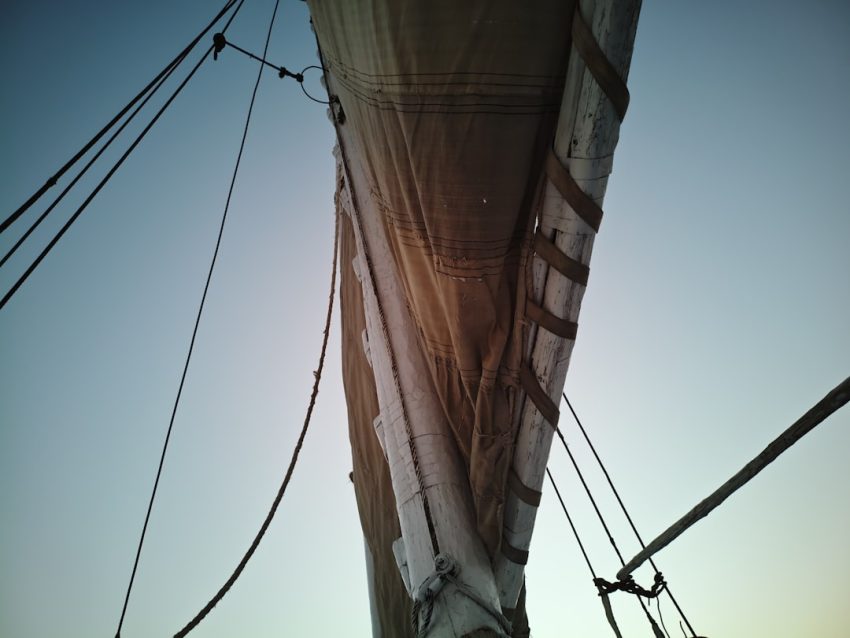
The Language of the Lines
Sail rigging terms form the essential vocabulary for understanding how a boat’s lines, stays, and hardware control the sails and support the mast. Whether you’re a new or experienced sailor, these terms connect you to centuries of maritime tradition.
Quick Reference: Essential Sail Rigging Terms
- Standing Rigging: Static cables and wires that support the mast (forestay, backstay, shrouds)
- Running Rigging: Dynamic lines used to control sails (halyards, sheets, control lines)
- Halyards: Lines that raise and lower sails
- Sheets: Lines that control the angle of sails to the wind
- Boom Vang: System that controls the boom’s vertical position
- Turnbuckle: Hardware device used to tension standing rigging
- Gooseneck: Pivoting connection between boom and mast
- Chainplate: Deck fitting that anchors standing rigging to the hull
A sailboat’s rigging has two main systems. Standing rigging consists of fixed wires like the forestay, backstay, and shrouds that keep the mast upright. Running rigging includes all the adjustable lines—halyards to hoist sails, sheets to trim them, and control lines to fine-tune sail shape.
Understanding these terms is vital for safety, effective crew communication, and appreciating the craftsmanship of vessels like the Friendship Sloop “Liberty” that we sail in San Diego. Each line has a specific name and purpose, refined over generations.

Standing Rigging: The Structural Support System
Standing rigging is the system of static wires and cables providing constant structural support to the mast. Unlike running rigging, it is not adjusted while sailing. Made from materials like stainless steel wire rope, it withstands the immense forces of the wind, keeping the mast upright and stable so we can harness the wind effectively on San Diego Bay.
The Core Components of Standing Rigging
- Forestay: A wire running from the mast to the bow, preventing the mast from falling backward. It often holds the headsail, sometimes with a roller-furling system.
- Headstay: Often used interchangeably with forestay, this wire runs from the masthead (the very top) to the bow, supporting the mast from the front.
- Backstay: Running from the masthead to the stern, the backstay counters the pull of the forestay. Adjustable backstays allow for fine-tuning mast bend and sail shape for better performance.
- Shrouds: These wires run from the mast to the sides of the boat, providing lateral (side-to-side) support and keeping the mast straight.
- Spreaders: Horizontal struts extending from the mast that hold the shrouds out. This increases the support angle, making the shrouds more effective at distributing loads.
For a deeper dive, explore resources like the [Rigworks guide to standing rigging](https://rigworks.com/standing-rigging-or-name-that-stay/).
Attachment and Tensioning Hardware
The strength of standing rigging also depends on its attachment hardware:
- Turnbuckle: A threaded device used to precisely adjust the tension of stays and shrouds. Rotating the barrel lengthens or shortens the assembly, tightening or loosening the wire.
- Shroud Adjuster: Similar to a turnbuckle, this is used to fine-tune shroud tension, which is key to keeping the mast straight.
- Chainplate: A heavy-duty metal plate bolted to the hull that anchors the standing rigging, distributing the high loads into the boat’s structure.
- Tang: A metal fitting on the mast where a stay or shroud attaches.
- Stemhead Fitting: A specialized fitting at the bow that serves as the attachment point for the forestay or headstay.
- Deck Plate: A fitting on the deck through which lines or wires may pass or be secured, sometimes as part of the standing rigging attachment system.
Running Rigging: The Lines for Sail Control
While standing rigging is the mast’s fixed skeleton, running rigging is the dynamic system of ropes used to control the sails. We actively adjust these lines to hoist, trim, and shape the sails, allowing us to adapt to changing wind conditions. Modern running rigging uses high-strength, low-stretch synthetic fibers like Dyneema, Vectran, and Technora. On “Liberty,” our running rigging is our direct connection to the power of the wind.
Lines for Hoisting and Shaping Sails
These lines get sails up and down and adjust their basic shape:
- Halyard: A line used to hoist (raise) a sail up the mast. Tensioning the halyard affects the shape of the sail’s leading edge (luff).
- Topping Lift: A line from the masthead to the end of the boom, supporting the boom’s weight when the mainsail is down. It is eased when sailing.
- Cunningham: A control line that pulls down on the mainsail’s luff to increase tension, which moves the sail’s draft (curve) forward and flattens it in stronger winds.
- Outhaul: A line that pulls the mainsail’s clew (aft lower corner) along the boom. Tightening it tensions the foot of the sail, flattening it.
- Downhaul: Similar to a cunningham, a downhaul pulls down on the sail’s luff to add tension. It can also refer to a line used to pull down a spinnaker pole.
- Boom Vang (or Kicker): A system (often a block-and-tackle) that pulls the boom down, controlling leech tension and preventing the boom from rising, especially when sailing downwind.
- Leech and Foot Lines: Thin lines along the edges of a sail used to fine-tune tension and prevent flutter.
For more details, check out [Basic Running Rigging Terminology with upffront.com](https://www.yachtsandyachting.com/news/214393/Basic-Running-Rigging-Terminology).
Lines for Trimming and Adjusting Sail Angle
Once hoisted, these lines control the sail’s angle to the wind:
- Sheet: The general term for a line that controls a sail’s angle by pulling it in (trimming) or letting it out (easing). Sheets attach to the clew of the sail.
- Mainsheet: Controls the mainsail’s angle and is usually run through a system of blocks for mechanical advantage.
- Jib Sheet: Controls the headsail (jib or genoa). Boats typically have two, one for each side, with the leeward (downwind) sheet being the active one.
- Traveler: A track and car system that allows the mainsheet’s attachment point to be moved side-to-side, adjusting the mainsail’s angle to the boat’s centerline.
- Barber Hauler: A line used to adjust the sheeting angle of the headsail, pulling the sheet inboard or outboard to optimize sail shape.
- Preventer: A safety line run from the boom’s end to a point forward on the deck. It prevents an accidental jibe when sailing downwind.
- Jiffy Reefing: A system of lines that makes it quick and easy to reef (reduce the area of) the mainsail in increasing wind.
Specialized sail rigging terms for Spinnakers
Spinnakers are large downwind sails with their own set of control lines:
- Spinnaker Guy (or Brace): On a symmetrical spinnaker, this line controls the spinnaker pole.
- Afterguy: On larger boats, the line running through the spinnaker pole’s jaw, taking most of the load.
- Foreguy: A line that pulls the spinnaker pole down, preventing it from lifting too high.
- Twing: A line that pulls the spinnaker sheet or guy down and inboard to help control the sail’s trim.
- Pole Topping Lift: Supports the spinnaker pole’s weight and adjusts its height.
- Pole Downhaul: Pulls the spinnaker pole down, counteracting the topping lift.
- Tack Line: On an asymmetrical spinnaker, this line controls the height and tension of the forward lower corner (tack).
Masts, Booms, and Essential Hardware
Beyond lines, a sailboat’s rigging relies on spars (masts and booms) and specialized hardware. These components provide the framework and adjustment mechanisms for sail control. On our Friendship Sloop “Liberty,” these elements are carefully maintained for historical accuracy and performance. You can [learn more about our boat and its features](https://sandiegosailingadventures.com/our-boat/) to see them in action.
Key Fittings on the Mast and Boom
- Gooseneck: A pivoting fitting that connects the boom to the mast, allowing it to move vertically and horizontally.
- Vang Plate: A strong fitting on the underside of the boom where the boom vang system attaches.
- Masthead: The very top of the mast, which houses sheaves (pulleys) for halyards, lights, and attachment points for stays.
- Sailfeed: The opening or slot on the mast or boom where the sail is fed into its track.
- Sailfeed Gate / Stop: A gate at the bottom of the sailfeed that prevents the sail from accidentally sliding out of the track.
- Mast Step: The structure that secures the base of the mast to the boat, either on the deck or down on the keel.
- Tabernacle: A hinged deck fitting that supports the mast and allows it to be pivoted for easy raising and lowering, common on trailerable boats.
For a comprehensive list, refer to the [Dwyer Mast Glossary of Rigging Terms](https://dwyermast.com/glossory).
Deck Hardware and Other Fittings
- Winch: A powerful mechanical device used to tension lines like sheets and halyards, providing a mechanical advantage to handle heavy loads.
- Cleat: A horned fitting used to secure a line by wrapping it in a specific pattern.
- Block: A pulley used to change a line’s direction, reduce friction, or create mechanical advantage.
- Fairlead: A fitting that guides a line in a specific direction to prevent chafing.
- Shackle: A U-shaped metal link with a pin, used to connect lines to sails or other hardware.
- Gudgeon and Pintle: A pair of fittings that function like a hinge to mount the rudder to the boat.
- Eyestrap: A simple metal loop bolted to the deck or mast, serving as an attachment point for blocks or other hardware.
Common Rig Types and Their Terminology
Sailboats feature various configurations, each with unique sail rigging terms. The rig type dictates the masts, sails, and rigging arrangement. While our “Liberty” is a classic sloop, it’s useful to know other common types:
- Sloop: The most common rig, with one mast, a mainsail, and one headsail (jib or genoa).
- Cutter: A single-masted rig with two headsails (a staysail and a jib), offering more sail plan flexibility.
- Ketch: A two-masted boat where the shorter aft mast (mizzen) is stepped forward of the rudder post.
- Schooner: A two-masted boat where the foremast is shorter than or equal to the aft mast.
Key differences in sail rigging terms and setups
Within the sloop configuration, two primary rig types exist:
- Masthead Rig: The forestay attaches at the very top of the mast (the masthead). This allows for a large, powerful headsail and creates a simple, strong rig.
- Fractional Rig: The forestay attaches below the masthead (e.g., 7/8ths of the way up). This results in a smaller headsail and a larger mainsail. It allows the mast to bend, which, when controlled by the backstay, is a key way to adjust sail shape and depower the mainsail, making it popular for performance sailing.
| Feature | Masthead Rig | Fractional Rig |
|---|---|---|
| Forestay Attach. | To the very top of the mast (masthead) | Below the masthead (e.g., 7/8ths or 3/4ths up) |
| Headsail Size | Generally larger, full height of mast | Generally smaller relative to mainsail |
| Mainsail Size | Proportionally smaller than headsail | Proportionally larger than headsail |
| Mast Bend | Less control over mast bend | More control over mast bend via backstay |
| Shrouds | Typically attach near masthead | Can attach at various points to allow mast bend |
| Power/Depower | Headsail is primary power source; depowering by reefing/furling headsail | Mainsail is primary power source; depowering via mast bend and mainsail trim |
| Performance | Good for all-around cruising, powerful headsail | Favored for racing and fine-tuning sail shape |
Understanding these differences helps clarify how various boat designs achieve their sailing characteristics.
Frequently Asked Questions about Sail Rigging
We often get questions about rigging terminology. Here are answers to some of the most common ones:
What is the difference between standing rigging and running rigging?
This is a fundamental distinction in sailing:
- Standing Rigging: The static wires and cables that permanently support the mast, like the forestay, backstay, and shrouds. They are not adjusted while sailing.
- Running Rigging: The dynamic ropes that are actively adjusted to control the sails, such as halyards (to hoist) and sheets (to trim).
In short, standing rigging provides support, while running rigging provides control.
What are the three corners of a sail called?
Every triangular sail has three named corners:
- Tack: The lower-forward corner, attached to the mast (mainsail) or bow (headsail).
- Clew: The lower-aft corner, where the sheets (for a headsail) or outhaul (for a mainsail) attach.
- Head: The top corner, where the halyard attaches to hoist the sail.
How do you tension the standing rigging?
Tensioning standing rigging is a critical maintenance task to keep the mast straight and improve performance. It’s done using:
- Turnbuckles: The primary devices for adjusting tension. Rotating the barrel of a turnbuckle tightens or loosens the attached stay or shroud.
- Shroud Adjusters: Similar threaded devices used specifically to fine-tune the tension of the shrouds.
The process involves careful adjustments to achieve the manufacturer’s recommended tension, ensuring the mast can withstand sailing forces.
Conclusion: Master the Rigging, Master the Sail
Understanding sail rigging terms is key to the art and science of sailing. From the support of standing rigging to the control of running rigging, this vocabulary empowers you to sail safely and efficiently.
Mastering these terms improves communication and allows for precise adjustments that optimize performance. Whether you’re aiming for a leisurely cruise or a spirited sail, knowing your halyards from your sheets makes all the difference.
At San Diego Sailing Adventures, we believe in learning by doing. Aboard “Liberty,” our restored 1904 Friendship Sloop replica, we show you how these terms work in real time on the beautiful waters of San Diego Bay. Our captain-hosted tours offer a unique opportunity to see how each part of the rigging contributes to the magic of sailing.
We invite you to continue your sailing journey with us. Learn more [About Us](https://sandiegosailingadventures.com/about-us/) and find the joy of traditional sailing. If you have more questions or are ready to experience it firsthand, please [Contact](https://sandiegosailingadventures.com/contact/) us. To expand your nautical lexicon, [continue your journey by learning more basic sailing terms](https://sandiegosailingadventures.com/2016-5-2-basic-sailing-terms/) on our website. Happy sailing!