
Why San Diego Bay Has Been the Heart of the Region for Centuries
Historic San Diego Bay has served as a vital crossroads for over 10,000 years—first as home to the Kumeyaay people, then as Spain’s foothold in Alta California, and eventually as one of the Pacific Coast’s most important naval and commercial harbors. Today, the bay’s 12-mile stretch of protected water reflects layers of maritime heritage, from the replica of Cabrillo’s San Salvador to the Navy’s aircraft carriers anchored at North Island.
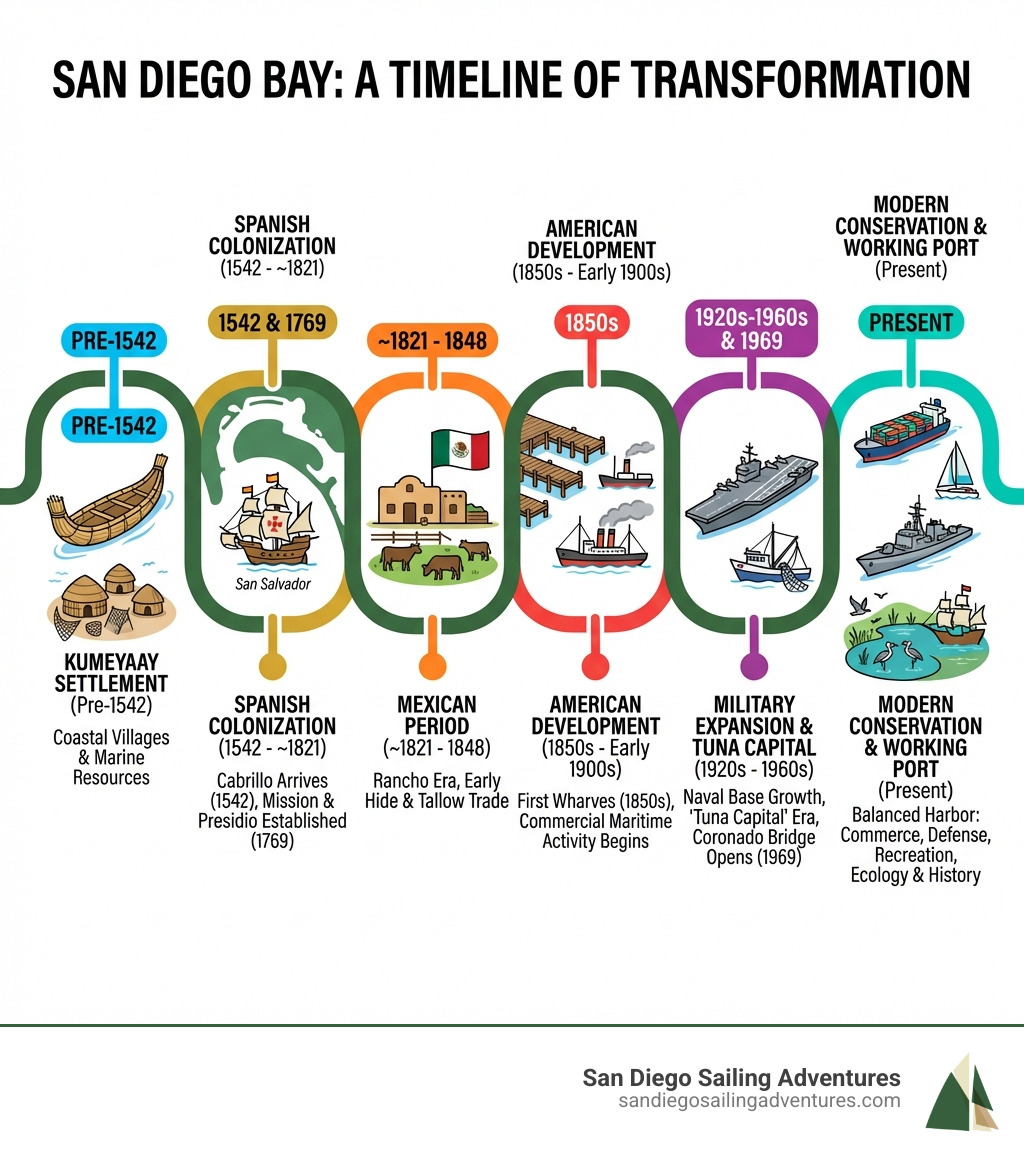
Key Historical Milestones of San Diego Bay:
- Pre-1542: Kumeyaay villages thrived along the shores, relying on the bay’s rich marine resources
- 1542: Juan Rodriguez Cabrillo became the first European to enter the bay, claiming it for Spain
- 1769: Spanish colonization began with the establishment of the Presidio and Mission San Diego
- 1850s: American settlers built the first wharves, marking the start of commercial maritime activity
- 1920s-1960s: San Diego became the “Tuna Capital of the World,” with canneries lining the waterfront
- 1969: The San Diego-Coronado Bridge opened, connecting the bay’s shores and allowing naval vessels to pass beneath
- Present: The bay serves as a working port, naval base, recreational destination, and living museum with ten historic ships
The bay’s change from a natural tidal marsh to a deepwater harbor required dredging 25 million cubic yards of sand and silt—material used to create Harbor Island and Shelter Island. Meanwhile, the redirection of the San Diego River into what is now Mission Bay reshaped the entire coastline.
As Philip Schutt, founder of San Diego Sailing Adventures, I’ve spent years guiding guests through these same waters where Spanish galleons once anchored and tuna clippers departed at dawn. Sailing across the historic San Diego Bay offers a perspective you simply can’t get from shore—where naval heritage, maritime commerce, and natural beauty converge in one protected harbor.
The Origins of the Historic San Diego Bay
Long before European ships graced its calm waters, the historic San Diego Bay was a vibrant home to indigenous communities. For over 10,000 years, the Kumeyaay people thrived along its shores, establishing villages like Cosoy (near what is now Old Town San Diego). These early inhabitants relied on the bay’s abundant marine resources, creating a deep connection to this beautiful natural harbor. The bay was a source of sustenance, a gathering place, and a critical transportation corridor for their canoes and traditions.
The rich history of the bay truly began to be documented with the arrival of European explorers. In 1542, Portuguese explorer Juan Rodriguez Cabrillo, sailing under the Spanish flag, became the first European to enter the bay. He named it San Miguel, but it was later renamed San Diego by Sebastian Vizcaino in 1602. Cabrillo’s arrival marked a pivotal moment, ushering in centuries of change for this tranquil coastal haven.
You can almost feel the weight of history as we sail past these ancient shores, knowing that countless generations have gazed upon these same waters. The bay, originally a vast expanse of Historical Wetlands of the Southern California Coast, has always been a place of immense natural beauty and strategic importance. To truly appreciate its journey, we invite you to dig deeper into San Diego Bay’s Storied Past: A Journey Through Time.
The First Maritime Encounters
Following Cabrillo’s initial visit, the bay remained largely untouched by European settlement for over 200 years. It was Sebastian Vizcaino who, in 1602, carefully mapped the bay and its surrounding areas, giving many of the landmarks their enduring names, such as Point Loma. His detailed charts provided the first comprehensive understanding of this natural harbor’s potential.
The early Spanish explorers recognized the bay’s strategic value, noting its protected waters and favorable conditions. While sailing aboard “Liberty,” our beautifully restored 1904 Friendship sloop replica, we often reflect on the simple yet robust vessels of those early maritime adventurers. Their journeys highlight the enduring principles of sailing, a testament to the Friendship Sloop History and the universal appeal of wind and sail.
Spanish and Mexican Influence
Permanent European presence began in 1769, when Gaspar de Portolá’s expedition established a presidio (fortress) and Mission San Diego de Alcalá on Presidio Hill, overlooking the bay. This marked the birth of European California. The bay quickly became a crucial port for the Spanish, though its shallow entrance often presented challenges for larger ships. Fort Guijarros was later built on Point Loma to protect the entrance, safeguarding Spanish interests.
During the Mexican period (1821-1848), following Mexico’s independence from Spain, the bay continued its role as a regional trade hub. The hide and tallow trade flourished, with ships exchanging manufactured goods for cattle hides and fat, which were then shipped around the world. This era saw the bay’s shores become busy centers of commerce, laying the groundwork for San Diego’s future as a major port. The evolution of maritime trade, from these early days to the clippers and luxury yachts of today, is a fascinating journey, as explored in History of Sailing in San Diego: From Clippers to Luxury Yachts.
Evolution of the Waterfront: From False Bay to Modern Commerce
The physical and functional evolution of the historic San Diego Bay is a story of human ingenuity meeting natural potential. Originally, much of the bay, particularly its northern reaches, was a shallow tidal marsh. The San Diego River, notorious for shifting its course, would sometimes empty directly into the bay, depositing silt and sand that continually altered its contours.
Early American settlers, like William Heath Davis, recognized the bay’s deepwater potential, establishing “New San Diego” in 1850 with a wharf to attract shipping. However, the true change began in earnest in the late 19th and 20th centuries with massive dredging projects. These efforts deepened the main shipping channels, allowing larger vessels to enter and dock, and fundamentally reshaped the bay’s shoreline. The scale of this engineering feat is impressive: 25 million cubic yards of sand and silt were dredged, much of which was used to create new landforms, including Harbor Island and Shelter Island, and even contributed to the expansion of the San Diego International Airport.
We, as sailors, often marvel at how drastically the bay has changed. What was once a shifting landscape of mud-flats and marshes is now a carefully maintained deepwater port, capable of handling significant cargo. The bay’s physical evolution directly enabled its functional shift from a natural refuge to a busy center of commerce and military activity. For a deeper look into the bay’s commercial past, consider the insights from the Report of the Commissioner of Corporations on Transportation by Water in the United States. Today, you can still experience the charm of the past while strolling through areas like A Stroll Through Seaport Village: Where San Diego’s Past Meets Present.
Engineering a Natural Harbor
The area known today as Mission Bay was originally a tidal marsh that Juan Rodriguez Cabrillo named “False Bay” in 1542. This “False Bay” historically received much of the San Diego River’s flow. To prevent the river from continuously silting up the main San Diego Bay, a dike was constructed in 1852. While this early attempt was short-lived, it set the precedent for future efforts to manage the river’s course.
The comprehensive development of Mission Bay into the largest man-made aquatic park in the United States began in the 1940s. This change involved extensive dredging and filling operations, turning the marsh into a series of channels, islands, and recreational areas.
The Port of San Diego, established to manage the bay’s resources, plays a critical role in its ongoing functionality. It oversees commercial shipping, cruise ship operations, and environmental stewardship. The Port handles more than 3 million metric tons of cargo yearly, a testament to the bay’s enduring economic importance. This strategic management is part of the broader OVERVIEW OF SAN DIEGO REGION WATERSHED MANAGEMENT AREAS, ensuring the bay’s health and utility for generations to come.
The Rise of the Tuna Capital
From the early 20th century through the 1960s, San Diego proudly held the title of “Tuna Capital of the World.” The bay’s deep waters and proximity to rich fishing grounds made it an ideal base for the burgeoning tuna industry. Fishing fleets, often employing skilled Portuguese and Italian immigrants, would set out from the bay, returning with abundant catches that fueled a thriving cannery industry along the waterfront.
This era saw a significant boom in the local economy and culture, with the fishing industry providing jobs and shaping the identity of entire communities. While the large-scale tuna canning operations have since moved on, their legacy remains a cherished part of San Diego’s history. We often share stories of these intrepid fishermen and their sturdy vessels, which, much like the traditional sails we admire, were built for purpose and resilience. Exploring the nuances of Traditional Sails helps us appreciate the maritime heritage that defined this period.
Preserving the Historic San Diego Bay Maritime Heritage
The historic San Diego Bay is not just a working port and naval base; it’s a living museum, preserving centuries of maritime history. Nowhere is this more evident than along the Embarcadero, home to the Maritime Museum of San Diego and its impressive fleet of historic ships.
A Fleet of Floating History
The Maritime Museum of San Diego is a treasure trove, featuring ten museum ships that allow you to step back in time. Among them is the magnificent Star of India, launched in 1863, which is the world’s oldest active sailing ship and the oldest iron-hulled merchant ship afloat. Imagine the voyages she undertook, sailing around the globe, before finding her permanent home here. You can literally walk her decks and feel the history beneath your feet.
Adjacent to her are other remarkable vessels like the HMS Surprise, a replica 18th-century frigate, and the San Salvador, a meticulous reconstruction of Cabrillo’s flagship from 1542. These ships aren’t just static displays; they represent the spirit of exploration, trade, and naval power that shaped San Diego. For us, sailing “Liberty,” our own 1904 gaff-rigged sloop, gives us a profound connection to these grand old ships and the sailors who worked them. We also remember the incredible contributions of those behind the scenes, such as The Women Who Built the USS Midway, whose efforts were vital to our naval strength.
Military Presence and Naval Aviation
The bay’s strategic location has made it a cornerstone of U.S. military operations, particularly for the Navy. Naval Air Station North Island, located on Coronado, has been a critical hub for naval aviation since its establishment. It remains a home port for several aircraft carriers, a truly awe-inspiring sight as you sail past them. The bay’s role in military history is immense, from World War II to the present day.
The USS Midway Museum, an aircraft carrier turned museum, offers an immersive experience into naval life and aviation history. Just think of the countless sailors and aviators who passed through these waters. The Marine Corps Recruit Depot (MCRD) San Diego also has a long-standing history here, contributing to the region’s military identity. Our own “Liberty” has sailed past these iconic military installations countless times, a reminder of the bay’s enduring importance. It’s a powerful feeling to be out on the water, watching the modern Navy at work, and knowing the long history of maritime defense that has unfolded here. We find that our guests often express a profound sense of awe when they witness the sheer scale of the naval presence. This rich military history, particularly naval aviation, has been celebrated, as seen during the Naval Aviation Centennial, and we’re proud to share these stories. It truly feels special to be a part of this living history, much like the excitement around Liberty’s First Sail when she first took to the water.
Iconic Architecture and the Coronado Bridge
One of the most striking architectural features of the historic San Diego Bay is the iconic San Diego-Coronado Bridge. Completed in 1969, this gracefully curving structure connects San Diego to Coronado, replacing the long-standing ferry system. The bridge’s design is not just aesthetically pleasing; it’s functional, with a height that rises to 200 feet above the water to allow Navy ships to pass underneath. While not tall enough for the largest Nimitz-class aircraft carriers, it still symbolizes the dual nature of the bay—a pathway for commerce and a home for the military.
Across the bay, the majestic Hotel del Coronado, built in 1888, stands as a testament to Victorian-era grandeur and a landmark of luxury and history. Its distinctive red turrets and sprawling architecture have welcomed presidents, royalty, and countless visitors for over a century. The bridge itself has its own history of evolution, including its transition from a toll bridge, as detailed in Coronado Bridge Toll To End. Sailing beneath this architectural marvel, with the Hotel Del in the distance, is an experience that truly connects you to the bay’s storied past and vibrant present.
Ecological Conservation and the Natural Beauty of the South Bay
Beyond its historical and commercial significance, the historic San Diego Bay is also a vital ecological treasure. The southern end of the bay, particularly around Chula Vista and Imperial Beach, is home to significant natural habitats. This includes the largest contiguous mud-flat in Southern California, which provides crucial feeding grounds for migratory birds.
The San Diego National Wildlife Refuge Complex, encompassing areas like the Sweetwater Marsh, represents a concerted effort to protect these fragile ecosystems. These refuges are critical stops along the Pacific Flyway, supporting a diverse array of bird species and other wildlife. For us, sailing quietly through these waters, we often observe the rich birdlife and appreciate the efforts being made to preserve the bay’s natural beauty. It’s a reminder that beneath the busy surface, a delicate balance of nature thrives.
Managing the Bay’s Health
The bay’s long history of industrial and military use, coupled with urban development, has inevitably led to environmental challenges, including pollution. Storm-water runoff and marine waste from shipping and shipbuilding have historically impacted the bay’s water quality. However, significant measures are in place for its management and remediation.
The Port of San Diego, along with various state and federal agencies, actively works on pollution control and ecological restoration projects. This includes efforts to clean up contaminated sediment, such as the Shipyards Sediment Site, and to manage storm-water discharge. Legal actions have also been taken, with the city and Port filing suit against companies like Monsanto for PCB contamination, highlighting the commitment to environmental recovery. While progress has been made, we remain vigilant. We are always mindful of the bay’s health, and it’s important for our guests to be aware of advisories like the San Diego Bay Fish Advisory concerning fish consumption. You can learn more about the scientific considerations behind bay management in reports like “Tidal Effect on Chemical Spill in San Diego Bay”.
Recreational Traditions on the Historic San Diego Bay
The waters of the historic San Diego Bay have always been a playground, evolving from early recreational boating to a vibrant hub for diverse activities and annual celebrations. Today, the bay hosts a myriad of events that draw locals and visitors alike.
One of the most beloved traditions is the annual Parade of Lights, which has been held since 1972. Decorated boats of all sizes illuminate the bay, creating a magical spectacle that truly embodies the holiday spirit. Another spectacular event is the Big Bay Boom, the Fourth of July fireworks display, which attracts half a million people each year to watch the dazzling show choreographed over the water. These events are a reminder of the community’s deep connection to the bay and the joy it brings.
America’s Cup Harbor, renamed in 1994 to honor the prestigious America’s Cup races held here, is a testament to the bay’s reputation as a world-class sailing venue. Small boat sailing, yachting, sport fishing, and whale watching tours are all popular activities. For us, sailing “Liberty” offers a unique way to experience these traditions, providing a calm and intimate perspective away from the crowds. We believe the timeless appeal of sailing, especially with a gaff-rigged vessel like ours, connects deeply with the bay’s enduring maritime spirit. Just as Liberty’s Gaff-Rig is Timeless, so too are the traditions that make the bay so special.
Frequently Asked Questions about San Diego Bay History
What is the historical significance of the San Diego-Coronado Bridge?
The San Diego-Coronado Bridge, built in 1969, holds immense historical significance as it dramatically changed transportation and connectivity in the region. Before its construction, the primary link between San Diego and Coronado was a ferry system that had operated for decades. The bridge replaced this system, making travel between the two cities faster and more efficient. Its distinctive curve and impressive height—rising 200 feet above the water—were specifically designed to allow large Navy ships, including many aircraft carriers, to pass underneath unhindered, underscoring the bay’s critical role as a naval hub.
How has the physical shape of the bay changed over time?
The physical shape of the historic San Diego Bay has undergone profound changes, evolving from a natural, shallow tidal marsh into the deepwater port we know today. Early maps show the San Diego River frequently shifting its course, often depositing silt into the bay and creating extensive mud-flats and shallow areas. Beginning in the mid-19th century and accelerating through the 20th century, massive dredging projects reshaped the bay. These operations deepened the main channels for commercial and military vessels and used the dredged material to create new land. This process led to the formation of artificial islands like Harbor Island and Shelter Island, significantly altered the shoreline, and contributed to the land base for the San Diego International Airport. The redirection of the San Diego River into Mission Bay was another monumental engineering feat that permanently changed the bay’s hydrology and physical form.
Which historic ships can you visit on the bay today?
The historic San Diego Bay is celebrated for its remarkable collection of historic vessels, offering a direct window into maritime history. Today, you can visit ten museum ships that call the bay home, primarily concentrated at the Maritime Museum of San Diego. Among the most prominent are the Star of India, a magnificent iron-hulled sailing ship launched in 1863 and recognized as the world’s oldest active sailing ship. Another notable vessel is the HMS Surprise, an authentic replica of an 18th-century British frigate. Furthermore, the San Salvador, a faithful recreation of Juan Rodriguez Cabrillo’s flagship from 1542, allows visitors to experience the earliest European exploration of the California coast. These ships, alongside the USS Midway aircraft carrier museum, provide unparalleled opportunities to immerse yourself in the bay’s rich maritime past.
Conclusion
The historic San Diego Bay is more than just a beautiful body of water; it’s a living chronicle of California’s past, a testament to human endeavor, and a vibrant part of our present. From the ancient traditions of the Kumeyaay to the Spanish explorers, the busy tuna industry, and its vital role in national defense, the bay has continuously shaped and been shaped by the region. Its evolution, marked by dramatic physical changes and enduring cultural significance, is a story we cherish deeply.
When you join us aboard “Liberty,” our exquisitely restored 1904 Friendship sloop replica, you’re not just taking a boat ride; you’re sailing through history. We offer intimate, captain-hosted sailing tours designed for small groups—a maximum of six guests—ensuring a personal and authentic experience. Feel the stillness of the water, the wind in the sails, and enjoy quiet conversations as you watch the sun sink behind the horizon. It’s an opportunity to create lasting memories, away from the crowds, with local beverages and our personal attention. This is a chance to truly connect with the soul of San Diego, experiencing its history and natural beauty from the unique perspective of the water.
We invite you to find the magic of the historic San Diego Bay with us. Explore private sailing options and let us guide you on a journey through time, where every wave tells a story.