
Why Finding the Right San Diego Whale Watching Package Changes Everything
San Diego whale watching packages range from budget-friendly 2.5-hour motor cruises to intimate private sailing charters — and choosing the right one makes all the difference between a rushed, crowded experience and a quiet, memorable encounter with some of the ocean’s largest creatures.
Here is a quick overview of the main package types available:
| Package Type | Typical Duration | Group Size | Best For |
|---|---|---|---|
| Standard cruise | 2.5 – 3.5 hours | 50-100+ passengers | Budget travelers |
| Private charter | 3 – 4 hours | Up to 10 guests | Groups, special occasions |
| Small-group sail | 3 – 3.5 hours | 6 guests max | Couples, intimate experiences |
| Bundle packages | Half-day | Varies | Families wanting extra activities |
| Sunset cruise | 2 – 3 hours | Varies | Romantic outings |
San Diego sits directly on the gray whale migration route, which means you don’t have to travel far offshore to witness something extraordinary. Gray whales pass within 3 to 5 miles of the coast during their southbound journey, while the return northbound trip takes them 9 to 12 miles out. Blue whales arrive each summer, and humpbacks can appear in any month of the year. The season you visit — and the type of tour you choose — shapes the entire experience.
What most visitors don’t realize is that the boat matters as much as the season. A large motor yacht carries over 100 passengers and gets you out quickly. A small sailing vessel carries six, moves quietly through the water, and lets you actually hear the ocean. Both have their place — but they are very different experiences.
I’m Philip Schutt, founder of San Diego Sailing Adventures, and I’ve spent my career leading intimate coastal sailing excursions along these same waters where the best san diego whale watching packages unfold. In the sections below, I’ll walk you through every major package type so you can find the one that fits your trip.
Choosing the Right San Diego Whale Watching Packages for Your Season
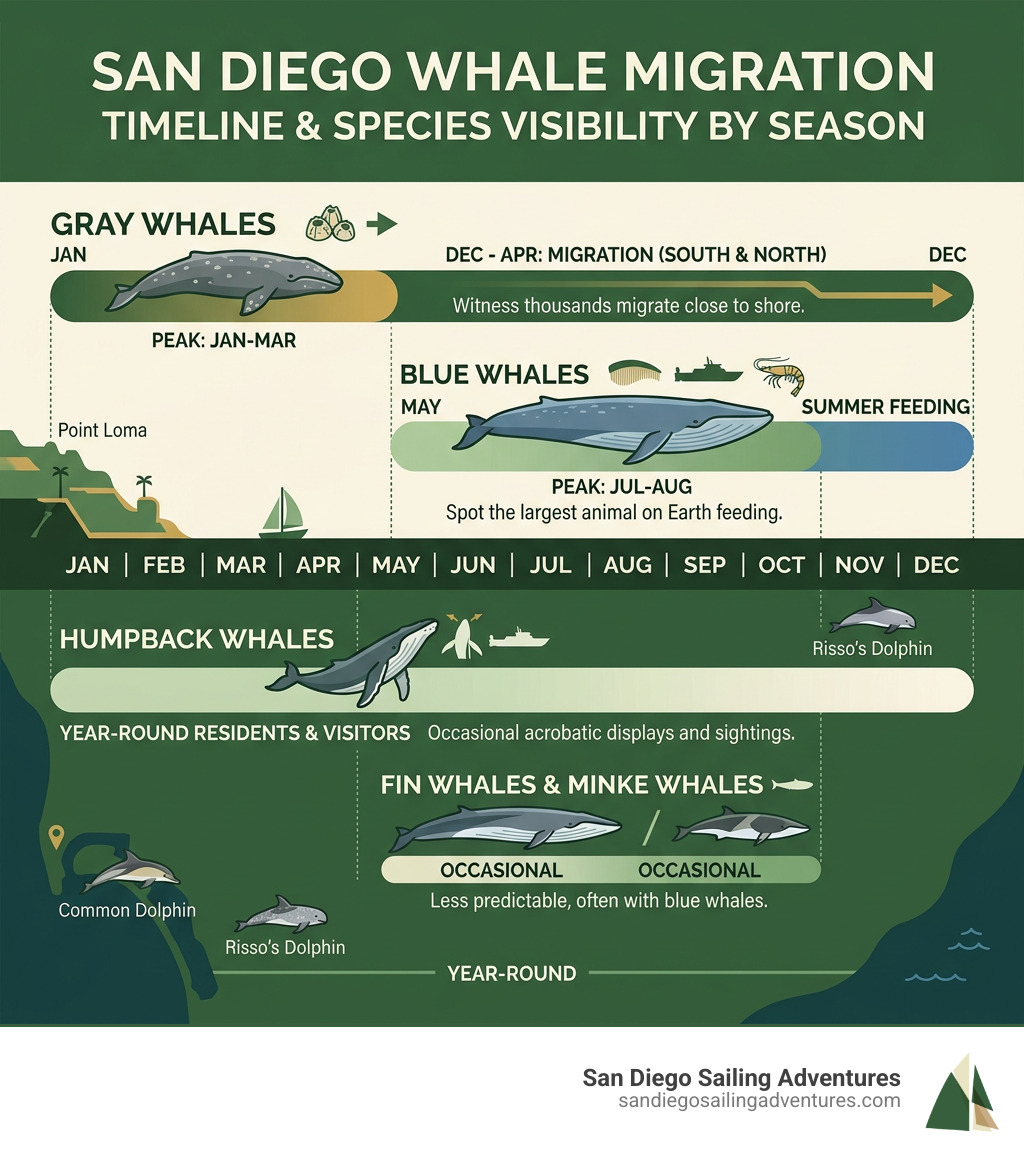
To get the most out of your time on the water, you first need to know who is visiting our coast. San Diego is a unique maritime crossroads where different species arrive at different times of the year. While some animals, like the acrobatic humpback whale, can be spotted during almost any month, others follow a strict migratory clock.
When you are browsing san diego whale watching packages, pay close attention to the dates. The “peak” season for one species might be the “off” season for another. Understanding these Baleen Whales seen off San Diego helps set your expectations for what you’ll see through your binoculars.
Winter and Spring: The Gray Whale Migration
From December through April, the star of the show is the Eastern Gray Whale. These incredible mammals undertake a 12,000-mile roundtrip journey—the longest migration of any mammal on Earth—traveling from the icy Bering Strait in Alaska down to the warm lagoons of Baja, Mexico.
During the early winter, you’ll see them heading south to mate and give birth. By February and March, the “return flight” begins. This is a particularly magical time for san diego whale watching packages because you might spot mothers traveling slowly with their young calves. These whales often hug the coastline, sometimes appearing just 3 to 5 miles offshore, making them very accessible even on shorter tours.
Summer and Fall: Searching for the Blue Whale
If you visit between June and September, you have the rare opportunity to see the largest animal to ever inhabit the Earth: the Blue Whale. These 90-foot giants are an endangered species, with only about 2,500 remaining in the North Pacific population.
Unlike the Gray Whales that are “just passing through,” Blue Whales come to the California coast specifically to feed on massive swarms of krill. Seeing a Blue Whale spout—which can shoot 30 feet into the air—is a heart-stopping moment. Because they follow the food, these tours often head a bit further out into the open Pacific, requiring a sturdy vessel and a captain who knows how to track the deep-water currents.
Maximizing Value in San Diego Whale Watching Packages
When comparing prices, look beyond the ticket cost. Many operators offer a “Whale Guarantee,” meaning if you don’t see a whale or a dolphin, your next trip is free. This provides great peace of mind, especially for families traveling from out of state.
You’ll also find bundle deals that combine a water adventure with land-based fun, such as admission to the San Diego Zoo or local museums. These are excellent for those who want a full “San Diego experience” in a single booking. Before you buy, it’s always wise to read more reviews to see how often sightings are actually occurring and how the crew handles the day-to-day conditions of the ocean.
Comparing the Experience: Large Vessels vs. Small Group Sails
There is a fundamental choice you have to make when booking: do you want to be on a ship or a boat?
Large motor yachts are common in San Diego. They often feature multiple decks, indoor seating, and snack bars. They are stable and fast, which is great for covering a lot of ground. However, they can also be crowded, with over 100 people vying for a spot at the rail when a whale surfaces. The drone of the engines can also be quite loud, which sometimes masks the natural sounds of the whales breathing.
On the other hand, a small-group sailing experience offers a completely different rhythm. Under sail, the only sounds are the wind in the canvas and the water against the hull. This silence allows for a much deeper connection with nature. When a whale breaches nearby, you hear the power of the splash without the interference of a diesel engine.
| Feature | Large Motor Vessel | Intimate Sailing Vessel |
|---|---|---|
| Noise Level | High (Engine drone) | Low (Wind and waves) |
| Crowd Size | 50 – 150+ people | 6 – 10 people max |
| Interaction | Loudspeaker narration | Personal conversation with Captain |
| Stability | Very stable, heavy | Gentle, rhythmic motion |
| Vibe | Sightseeing tour | Private adventure |
Specialized San Diego Whale Watching Packages for Private Groups
For those celebrating a milestone—like a 50th anniversary, a birthday, or even a proposal—a private charter is the gold standard of san diego whale watching packages. Having the entire boat to yourself means the itinerary can be adjusted to your preferences. If you want to spend an extra thirty minutes watching a pod of 2,000 Pacific White-Sided Dolphins play in the wake, we can do that. You can find more info about private charter services to see how an exclusive trip can be tailored to your group’s needs.
Onboard Amenities and Naturalist Guides
Most high-quality tours include a naturalist or a highly experienced captain who provides professional narration. They can identify the specific markings on a Humpback’s fluke or explain why a Gray Whale is “spy-hopping.”
On our boat, “Liberty”—a restored 1904 Friendship sloop replica—the experience is about more than just the whales; it’s about the history of the craft and the comfort of the journey. We focus on small details, like providing local beverages and comfortable seating that doesn’t feel like a plastic bench. You can learn more info about our boat and why its design makes it such a stable, peaceful platform for wildlife photography.
Planning Your Trip: Logistics, Routes, and Amenities
Most san diego whale watching packages depart from either San Diego Bay or Mission Bay. Each has its advantages. Tours leaving from Mission Bay are often closer to the open ocean, meaning you spend less time “commuting” and more time searching for wildlife.
The typical route depends entirely on where the whales were spotted the day before. Because whales don’t follow a GPS, our captains share information constantly. During the early season, we stay closer to the shore (3-5 miles). As the season progresses and the whales head north, we might venture 9 to 12 miles out.
The distance offshore also dictates the “feel” of the water. Closer to shore, the water is often calmer. Once you get further out, you might experience the long, rolling swells of the Pacific. This variability is why every trip is a little different, and why we always recommend checking the weather a day or two before your departure.
Essential Tips for a Comfortable Day on the Water
Even on a sunny San Diego day, the temperature on the water can be 10 to 15 degrees cooler than it is on land. The wind off the ocean is refreshing, but it can get chilly if you aren’t prepared. We want your focus to be on the horizon, not on how cold your hands are.
If you have specific questions about what to expect, it’s always a good idea to check our info about common questions before you head to the docks.
Managing Seasickness and Ocean Conditions
Seasickness can happen to anyone, but it shouldn’t ruin your trip. If you are prone to motion sickness, we recommend taking a preventative (like Dramamine or Bonine) about an hour before you board.
Morning tours often have the calmest waters, as the afternoon “sea breeze” hasn’t yet kicked up the chop. Staying hydrated and keeping your eyes on the horizon also helps your inner ear adjust to the motion of the boat. On a sailing vessel, the motion is often more of a rhythmic “heave” than the “vibration” you feel on a motorboat, which many guests find much easier on the stomach.
What to Bring for Your Whale Watching Adventure
To make the most of your san diego whale watching packages, pack a small “adventure bag” with these essentials:
- Binoculars: While whales are huge, they can be shy. A good pair of binoculars helps you see the barnacles on a Gray Whale’s back.
- Polarized Sunglasses: These cut the glare on the water, making it much easier to spot the dark shapes of whales or dolphins beneath the surface.
- Layers: A light, windproof jacket or a fleece is a must, even in summer.
- Camera with Zoom: Your phone is great for selfies, but a camera with a physical zoom lens will capture those distant breaches much better.
- Sun Protection: The sun reflects off the water, doubling your exposure. Bring a hat and sunscreen.
Frequently Asked Questions about San Diego Whale Watching
What is the best time of day to see whales in San Diego?
Whales are active throughout the day, so there isn’t a “magic hour” for sightings. However, morning trips (departing around 9:00 AM or 10:00 AM) often enjoy the flattest sea conditions. Afternoon trips might be slightly breezier but offer beautiful lighting for photography. Afternoon sails are a popular choice for those who want to combine whale watching with the warmth of the midday sun.
Are whale sightings guaranteed on every tour?
While we have a very high success rate—often over 90% during peak migration—these are wild animals in a vast ocean. Most san diego whale watching packages offer a “sighting guarantee” where you get a return voucher if no whales or dolphins are spotted. It’s always best to book your tour early in your vacation so you have time to use that voucher if needed!
Is whale watching suitable for young children and seniors?
Absolutely. It is a wonderful multi-generational activity. However, for very young children or seniors with mobility issues, the size of the boat matters. Large motor yachts are very easy to board, while smaller sailing vessels provide a more stable, seated experience once you are out on the water. If you’re looking for something extra special for a romantic evening or a quiet family gathering, a sunset cruise offers a slower pace that everyone can enjoy.
Conclusion
Finding the right san diego whale watching packages doesn’t have to be overwhelming. Whether you choose the bustling energy of a large cruise or the quiet, refined atmosphere of a sailing vessel, the goal is the same: to witness the majesty of the Pacific’s great migrators.
At San Diego Sailing Adventures, we believe the best way to see a whale is the way people have seen them for centuries—under sail. Our 1904 replica sloop, “Liberty,” offers an intimate, captain-hosted experience that avoids the crowds and noise of larger tours. With a maximum of just six guests, you aren’t just a passenger; you’re part of the journey.
If you’re ready to trade the loudspeakers for the sound of the wind and the spray of the sea, we invite you to join us. Plan your whale watching sail today and discover why the best way to see the giants of the deep is from the deck of a classic boat.